
The short answer
Which visit visa for parents? The four countries compared
A visit visa for parents is, in most countries, simply the ordinary visitor visa, applied for by the parents and judged on their own circumstances. The son or daughter abroad supports it with an invitation and evidence, but it is the parents’ file. Only Canada and Australia have visas built for parents who want long stays.
Every officer asks the question they ask any visitor: will these people go home at the end of the visit? A settled child abroad is the reason for the trip, and also the reason the officer looks closely at what the parents have in Pakistan.
| Country | The visa | How long each stay | Insurance and health checks |
|---|---|---|---|
| UK | Standard Visitor visa — six months, or a long-term visa of two, five or ten years | Up to six months per visit | Insurance isn’t a visa requirement, but visitors pay for most NHS hospital treatment; no TB test for a visit visa |
| Canada | Visitor visa, or the super visa for parents and grandparents of citizens and permanent residents | Usually up to six months on a visitor visa; up to five years at a time on a super visa | Super visa: a year’s qualifying medical insurance and a medical exam. A visitor from Pakistan staying more than six months also needs one |
| Australia | Visitor visa (subclass 600), Tourist or Sponsored Family stream; Sponsored Parent (Temporary) visa for long stays | Usually three months, up to 12; parents on longer visas no more than 12 months in any 18 | Health insurance required on longer parent visas; health checks at 75 and over, or for stays of six months or more |
| US | B1/B2 visitor visa | Set by the border officer and recorded on the I-94, usually up to six months | No insurance required by the visa, but US medical bills are notoriously high |
UK: the Standard Visitor visa for parents
Parents visiting children in the UK apply for the Standard Visitor visa, like any tourist, and each visit can last up to six months. Parents who will visit regularly can ask for a long-term visa valid for two, five or ten years with multiple entries. Each stay is still capped at six months, and the caseworker can issue a shorter visa than the one requested, with no refund of the difference.
The Home Office’s caseworker guidance answers a question many families ask. A relative coming to look after a child or another relative is allowed if the arrangement is temporary and informal and does not amount to working as a carer or child-minder. Helping for a few months after a grandchild is born is a visit; becoming the family’s permanent childcare is not.
The caseworker also reads the pattern of visits. Six months in the UK, a few weeks at home and another six months looks like living there, and can be refused under the frequent-visits rule. Our UK visit visa guide lists the documents for both sides.
Canada: visitor visa or super visa for parents?
Parents can visit Canada on an ordinary visitor visa, usually for up to six months at a time; the officer decides whether to issue single or multiple entry. For longer stays, parents and grandparents of Canadian citizens and permanent residents can apply for the super visa, which allows stays of up to five years at a time on a visa valid for up to ten years.
The super visa asks more of both generations. The child or grandchild signs a letter of invitation that promises financial support for the visit and lists everyone in their household, and must meet the minimum income IRCC sets for that household size. The parents need private medical insurance valid for at least a year from entry, and an immigration medical exam.
The insurance rules are strict. The policy must come from a Canadian insurer, or a foreign insurer authorised by Canada’s insurance regulator, and be paid in full or by instalments with a deposit; a quote is not enough. An ordinary Pakistani travel policy is unlikely to qualify.
Neither visa changes the core test: the officer must be satisfied the visit is temporary, and a super visa does not cure a refusal based on thin ties to Pakistan. See our post on a refused Canada visit visa, and the Canada visit visa guide for the Islamabad checklist.
Australia: the Sponsored Family stream and longer parent visas
Australia’s Visitor visa (subclass 600) has two streams that suit parents. In the Tourist stream they apply on their own, with the child’s invitation letter. In the Sponsored Family stream the child — an Australian citizen or permanent resident, usually settled there for two years — formally sponsors the visit and may be asked for a security bond, refunded if the parents keep to the visa’s conditions.
Stays are usually three months, and up to 12 in some cases. Parents of citizens and permanent residents can be granted a visa valid for more than a year, but cannot spend more than 12 months in total in any 18-month period, and must hold health insurance. Applicants aged 75 or over, and anyone staying six months or more, need health examinations.
For longer stays there is the Sponsored Parent (Temporary) visa, subclass 870: three or five years per visa, up to ten years in total. The child must first be approved as a parent sponsor, and the parents need Australian health insurance. Permanent parent visas exist too, but Home Affairs’ own estimates put their queues at decades.
US: the B2 visitor visa for parents
The US has no visa built for parents. They apply for the B1/B2 visitor visa and, in Pakistan, attend an interview at the US Embassy in Islamabad or the Consulate General in Karachi — in person, even if they are over 79. If they are admitted, the border officer sets how long they may stay and records it on the I-94, usually up to six months.
The State Department says an invitation letter or affidavit of support is not a factor in the decision. Parents qualify on their own ties to Pakistan, and should be able to answer questions about their child’s life in the US themselves; our guide to B1/B2 interview questions covers them. With interview waits measured in months, apply long before a due date or a graduation.
What should the child abroad send?
The child’s documents explain the visit and show it can be paid for. They support the parents’ application; they don’t replace it. Our guide to invitation and sponsor letters covers each country’s rules for the letter itself.
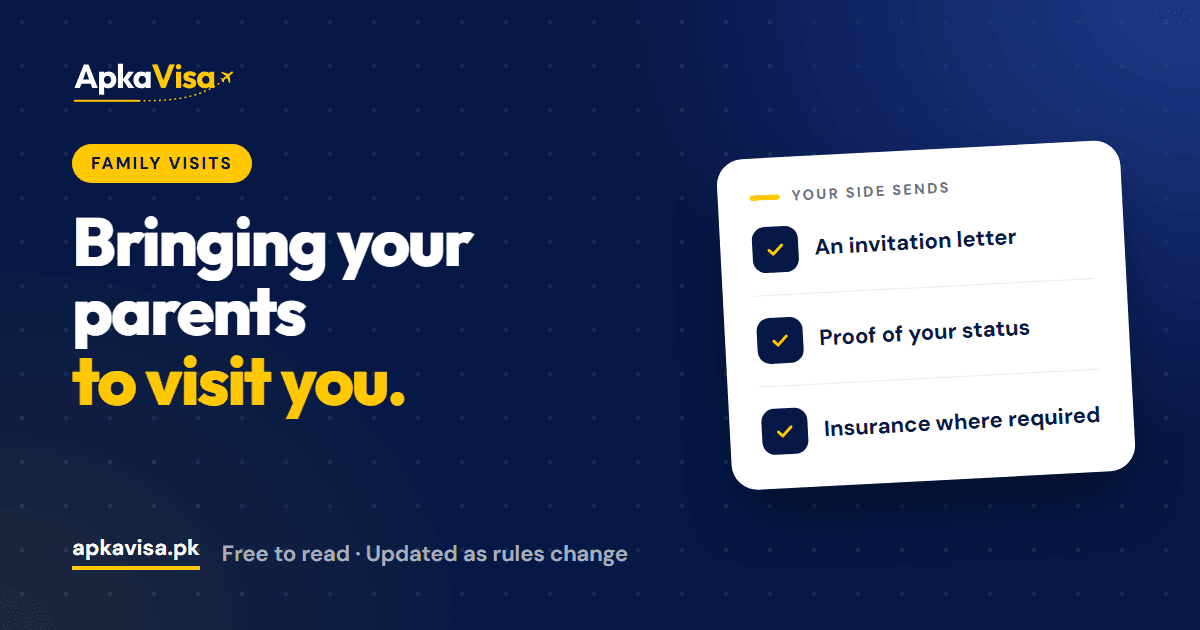
- An invitation letter: names, relationship, dates, where the parents will stay and who pays
- Proof of status: a passport, UK eVisa share code, Canadian PR card, Australian visa grant or US green card
- Proof of the relationship, such as a NADRA Family Registration Certificate, translated where needed
- If they are paying: recent payslips and bank statements
- For a Canadian super visa: proof of income, and the household list in the letter
- For Australia’s Sponsored Family stream: the formal sponsorship, and a bond if asked
Health insurance and medical checks for older parents
Insurance is compulsory only on some of these visas — Canada’s super visa, Australia’s longer parent visas and the 870 — but all four countries charge visitors for medical care. The UK charges visitors for most NHS hospital treatment, and US hospital bills are notoriously high. For parents, health cover is not optional in practice.
Read the policy for pre-existing conditions. Diabetes, heart disease and high blood pressure are common at this age, and a policy that excludes them may pay nothing when it matters. Declare every condition truthfully, because an undeclared one can void a claim. Check the age limits too: some policies stop at a certain age or offer less cover above it.
Medical exams depend on the country and the length of stay. Canada requires one for every super visa and for visitors from Pakistan staying more than six months. Australia requires one at 75 and over, or for stays of six months or more. The UK asks for no TB test on a visit visa, and the US asks for no medical from visitors.
The parents’ own ties to Pakistan
This is where parents’ applications are most often won or lost. The officer weighs the pull of children abroad against what the parents have in Pakistan, and the answer has to be in documents, not assurances.
Keep the first request proportionate, too. Two or three months and a return on time builds the record that makes a long-term visa or a super visa easier later. What helps most:
- A spouse, other children or grandchildren who stay in Pakistan
- The family home or other property in their own names
- A pension, business or rental income that continues while they travel
- Their own bank statements with a steady pattern, not money moved in to apply
- Old passports showing earlier trips that ended on time
- Commitments at home: a business, a family event, ongoing medical care
Frequently asked questions
This is general guidance