
The short answer
What is an NOC for a visa?
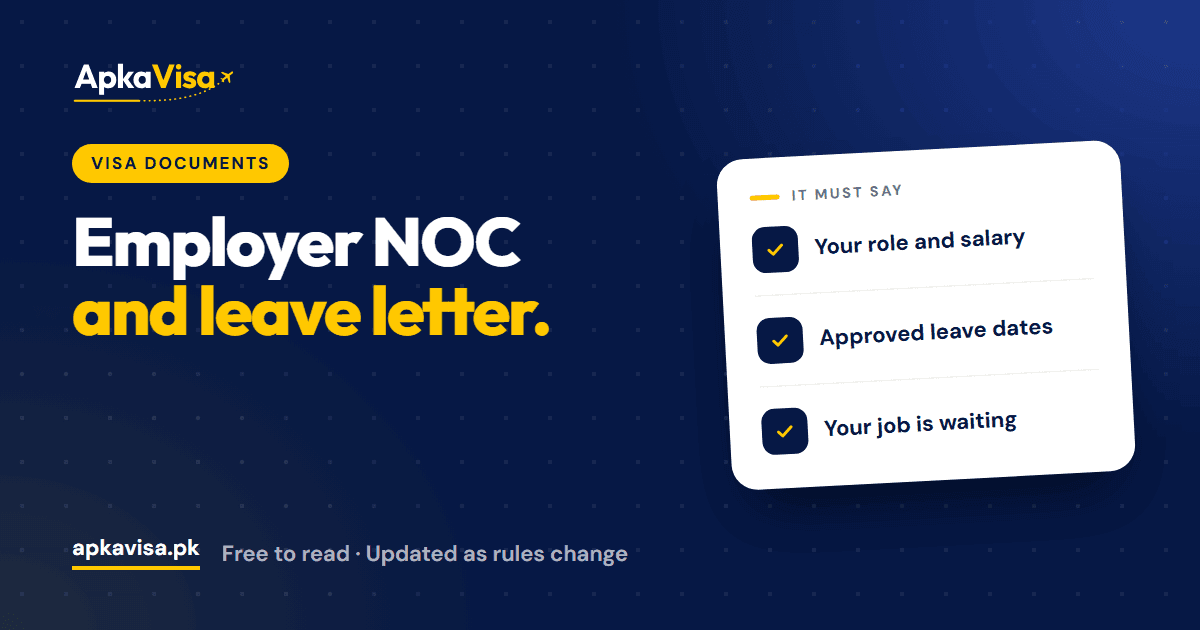
In Pakistan, “NOC” is used loosely. For a private employee, an NOC for a visa usually means an employment and leave letter: your employer confirming who you are, what you do, and that leave for the trip is approved. No rule requires a private company to issue something titled NOC; what consulates want is the content.
For government employees it is more formal. A civil servant needs departmental permission to travel abroad, recorded as sanctioned leave ex-Pakistan or a no-objection certificate, and the Schengen consulates in Pakistan ask for that document by name.
Either way, the letter answers the question every officer asks: will this person come back? A job that is waiting, with leave approved for exact dates, is one of the strongest answers you can give, especially for a first-time traveller with no past trips to point to.
What consulates want from an employer letter
The core is the same everywhere, but each country’s list adds its own details.
| Destination | What the letter should show | Also asked for |
|---|---|---|
| UK | Your role, salary and length of employment, on company letterhead, with your start date and the company’s contact details | Payslips that match the credits on your bank statement |
| Schengen | Approval of leave with the exact dates, your position, salary, length of employment, the purpose of the absence and the employer’s contact number | Payslips for the last three months and a copy of your employment contract |
| Germany | Your designation, how long you have worked there, and permission for the trip, as an original | Six months of bank statements and three months of salary slips |
| Canada | Leave granted, your name, position and current salary, and the employer’s name, address and phone | For business trips, the purpose and the companies you will visit |
| United States | No fixed list; a letter with role, salary and approved leave supports your answers | Your answers at the interview carry the case |
Where these requirements come from
The Schengen row is the European Commission’s list of documents for Pakistan, which the Schengen consulates here work from, some with additions of their own. Germany’s row is from its embassy’s tourist visa page, which calls the document an NOC and wants it from every employee.
Canada’s row is from the Islamabad visa office’s checklist, and the UK’s from its guide to supporting documents. The US is the odd one out: the decision is made at the interview, and documents only support what you say there.
What the letter must contain
Put all of this on one page and you have covered every country above.
- Company letterhead with full address, landline and official email
- A recent date
- Your full name as in the passport, and your CNIC or passport number
- Your designation and department
- Your start date, and whether the job is permanent or contract
- Your current salary, matching your payslips
- The approved leave, with first and last dates
- The purpose of the trip, in a few words
- That your job continues and you will resume work on a stated date
- The signatory’s name, designation, direct phone, signature and the company stamp
Letterhead, signatory and the verification call
Officers do check employer letters. The UK’s caseworker guidance tells staff to verify a doubtful document at source, and the Schengen list and Canada’s checklist both ask for the employer’s phone number for a reason. Tell HR or your manager that a call or email may come, and make sure whoever answers knows you and your dates.
The signatory should be someone with authority over your leave: HR, your manager or a director, not a colleague. A letter from a company with no landline and a Gmail address looks weak even when it is genuine, so add what supports it: your appointment letter, payslips, and the salary credits on your bank statement.
Never use a letter from a company you don’t work for, or one with an inflated title or salary. Canada’s checklist warns that fraudulent documents bring immediate refusal and a possible five-year ban; in the UK a deception finding brings ten years. The person carrying that ban is you, not whoever produced the letter.
NOC for government employees in Pakistan
If you work for the federal or a provincial government, an autonomous body, the armed forces, or a government school or hospital, the visa is only half of it. FIA’s Travellers’ Guide says government officials leaving Pakistan must have leave ex-Pakistan or a departmental NOC, and must declare their government status on their passport.
The leave is sanctioned by your department through its own channel. Federal leave orders usually state the number of days, the exact dates and that the department has no objection to travel to a named country, and are copied to FIA immigration. Apply weeks ahead: requests go up a chain, and provinces and departments set their own approval levels and notice periods.
The Schengen list asks civil servants for an NOC from the employing department stating the dates of the visit. For the UK and Canada, the leave order or NOC does the same job as a private employer’s letter, ideally with a separate certificate giving your designation, length of service and pay. If your dates move, get the order revised before you fly.
Self-employed, students and retired applicants
If you have no employer, other evidence replaces the letter. Business owners show registration, NTN, FBR returns and business bank statements; the UK accepts business registration documents or recent invoices that confirm ongoing self-employment. Students show enrolment, and Germany wants the university’s permission for the trip. Retired applicants show pension statements, which the Schengen list asks for covering six months.
If you have both a job and a side business, lead with the job. An employer letter and payslips are easier to verify, and the business becomes supporting evidence rather than the main story.
What if your employer won’t write one?
Some employers refuse, usually because of company policy or a worry that you are job-hunting abroad. Find out which, because it changes the fix.
- Ask HR for the company’s standard employment certificate, then add your approved leave application or the manager’s approval email
- Add your appointment letter or contract, recent payslips and the salary credits on your statement
- Include EOBI records if your employer registered you
- Explain in your cover letter why the evidence is in this form
Mistakes that weaken an employer letter
If your employer won’t even confirm your leave, think hard before applying: an officer who can’t see that your job is waiting has little reason to believe you will return. And never write your own letter on the company’s letterhead. One phone call exposes it. The other common faults are smaller but just as visible:
- Leave dates that differ from the bookings or insurance
- A salary that doesn’t match the payslips or bank credits
- No contact number, or a number nobody answers
- A letter dated months before the application
- Generic praise with no dates, salary or leave
- A start date only weeks ago, with nothing about your previous job
Frequently asked questions
This is general guidance