
The short answer
What is an SOP for a student visa, and who reads it?
People say “SOP for student visa” to mean several different documents. The university’s statement of purpose or personal statement is read by admissions staff deciding whether to offer you a place. The visa officer reads something else, or nothing written at all, depending on the country.
Canada recommends a letter of explanation with the study permit application. Australia asks four Genuine Student questions inside the application form. The UK and US visa applications contain no written statement; the credibility questions come at interview instead. Germany’s missions in Pakistan have listed a motivation letter on their student visa checklists.
Write the right document for the right reader. A university SOP that wins an offer can still fail as a Canadian letter of explanation, because it answers a different question.
University SOP or visa statement: which one are you writing?
The content overlaps, but the reader and the test differ. This is the difference in one table.
| Document | Who reads it | What it must show | Length |
|---|---|---|---|
| University SOP or personal statement | Admissions staff | Academic fit, motivation and readiness for the course | Set by the university; UCAS undergraduate statements answer three questions in 4,000 characters |
| Canada: letter of explanation | An IRCC officer | Why you want to study in Canada, that you understand a student’s responsibilities, and your funds and plans | No official limit |
| Australia: Genuine Student answers | A Home Affairs officer | Your circumstances, why this course and provider, and how it will benefit you | Up to 150 words per answer, in the form |
| UK and US | An officer, at interview | The same story, spoken | No written statement in the visa application |
| Germany: motivation letter | Embassy or consulate staff | Why this programme in Germany, and what follows it | Not fixed; keep it short |
What Canada and Australia actually ask for
IRCC’s study permit documents page lists the letter of explanation as recommended rather than required. It should explain why you want to study in Canada and show that you understand your responsibilities as an international student. In a Pakistani file it is often the only place an officer hears your reasons in your own words, so treat “recommended” as “expected”.
Australia’s Genuine Student page asks about your current circumstances, why this course with this provider, how it will benefit you, and anything else relevant. It prefers answers in the form rather than a separate statement, allows 150 words per answer and gives more weight to statements backed by evidence. A two-page SOP attached instead misses the point.
A structure for a statement of purpose that works
This order works for a university SOP and, with the funding and ties lines added, for a Canadian letter of explanation. For Australia, split the same content across the four questions.
- Opening: the course, the institution and the intake, in one or two plain sentences
- Where you are now: your degree, your results and any work since
- Why this course: two or three modules or skills, linked to something you have done
- Why this institution: facts that are not true of every other one on your list
- Why this country, and why not Pakistan
- Any gap or change of direction, explained briefly
- Who is paying, and from what income (visa letters only)
- What happens after: the role, the sector and the kind of employer in Pakistan
- Ties waiting at home: family, work or responsibilities (visa letters only)
- A short close that restates the plan, not a slogan
What visa officers look for in your statement
Officers are not grading prose. They read for a story that hangs together, then check it against your documents:
- Coherent progression: the course follows from your degree and work
- Specific, researched reasons for this course and country
- Funding that matches the bank statements and the sponsor’s income
- A believable plan for afterwards, and ties to come back to
- English that sounds like the person who will turn up at interview
Mistakes that sink a statement of purpose
Australia publishes what it weighs: why you are not studying at home if a similar course exists, your ties and economic circumstances, how much you know about the course and provider, and whether the course improves your job prospects. Weak statements usually fall short on one of these, in one of the ways below.
- Copied templates: officers see the same paragraphs from many applicants, and UCAS checks statements for similarity
- AI-sounding text: smooth, generic sentences that say nothing about you and that you can’t defend at interview
- Contradictions with the file: a different sponsor, different job dates or a different plan from the forms
- Overclaiming: invented job offers, research you didn’t do, promises to “revolutionise” an industry
- Writing about the country instead of the course: lifestyle, culture, part-time work
- Leaving out a gap or a refusal and hoping nobody notices
How long should an SOP be, and what tone works?
Follow the instruction you are given. A university may ask for 500 words or two pages; UCAS sets 4,000 characters across three questions, with a minimum for each; Australia allows 150 words per answer. Going over a limit doesn’t show commitment. It shows you didn’t read the instructions.
Canada sets no limit for a letter of explanation. One to two pages is enough for most people; longer letters tend to bury the two sentences the officer needs.
Use a plain, first-person tone. Write as you would speak in a careful interview: short sentences, real names, no quotations from famous people, no flattery of the country. Using a tool or a consultant to fix grammar is fine. Handing over the thinking is not — if you couldn’t explain a sentence out loud, cut it.
How to handle a study gap or a previous refusal in your SOP
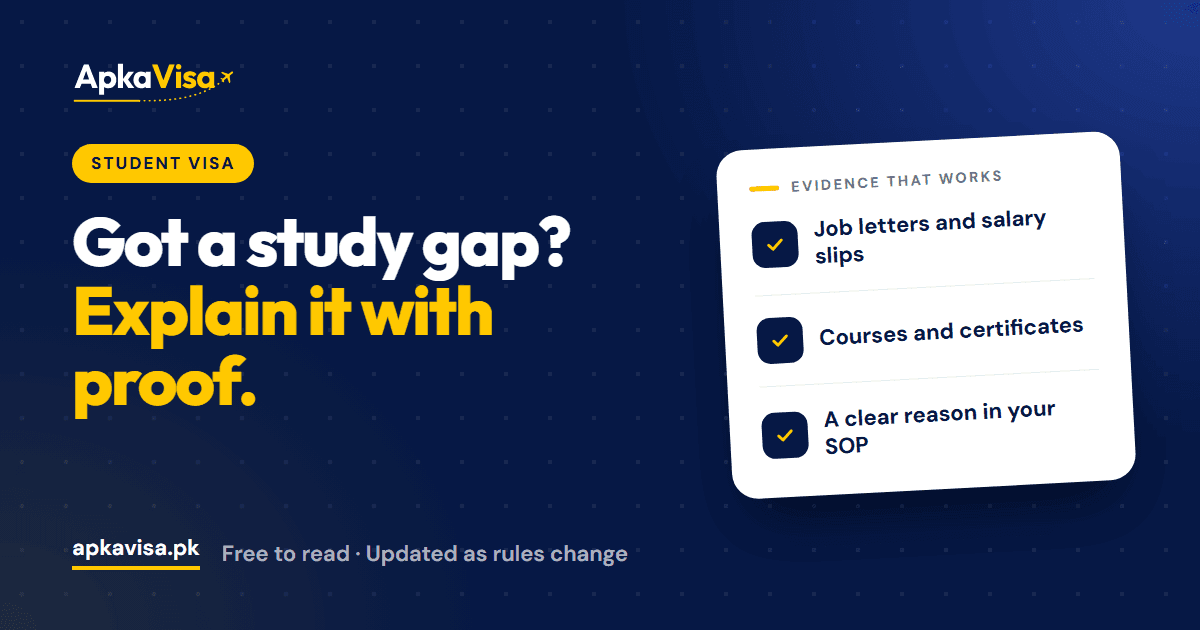
Deal with a gap directly, where it falls in your story: what you did, what it taught you, and why it leads to this course now. Then let documents carry the weight — an employment letter says more than a paragraph. Our post on explaining a study gap covers the evidence that works.
A previous refusal belongs in a visa letter too, especially for Canada, where the form asks about it anyway. Name it, say what the officer was concerned about — most IRCC refusals since 29 July 2025 come with the officer’s decision notes — and show what has changed. Don’t argue with the last officer; answer them. More in our post on a Canada study permit refusal.
Never leave a refusal from any country out of a statement or a form. It is misrepresentation, and it turns a fixable history into a ban. If a UK credibility interview is coming, your spoken answers should match your written ones — see UK student visa interview questions.
Frequently asked questions
This is general guidance