The short answer
What do F1 visa interview questions actually test?
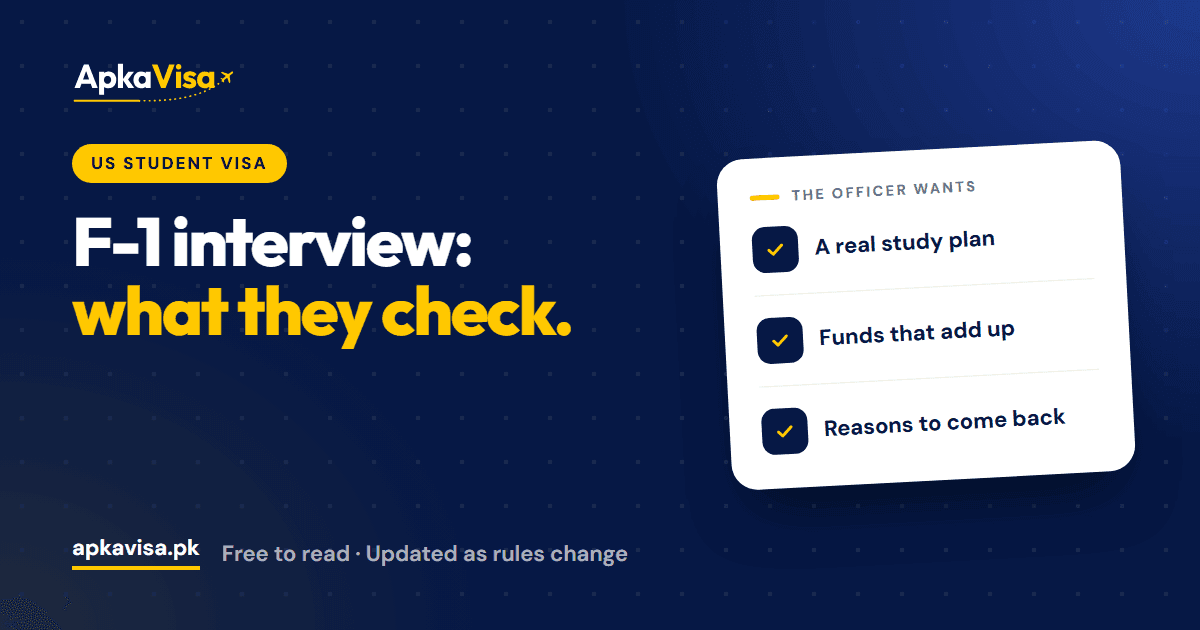
F1 visa interview questions can feel random, but they all lead back to what the law requires. Are you a genuine student at a real school? Can you pay for it? Do you have a residence in Pakistan you have no intention of abandoning? That last phrase comes from the F-1 definition in US immigration law, and it is the one applicants most often underprepare for.
The officer starts from an assumption. Section 214(b) of the Immigration and Nationality Act presumes every visa applicant is an intending immigrant until they show otherwise. You overcome that with your answers, in a short conversation at a window.
How the F-1 interview works in Islamabad and Karachi
Student visas are handled by the Embassy in Islamabad and the Consulate General in Karachi, and both say they prioritise student and exchange visitor (F and J) applications. Scheduling, fee payment and passport return go through the State Department’s contractor on the ustraveldocs site.
Since 11 August 2025, the US Mission says almost every nonimmigrant visa applicant in Pakistan needs an in-person interview. The only waiver it lists is for certain B1/B2 visitor renewals, so an F-1 applicant should expect to attend. Its nonimmigrant visa page also asks applicants to arrive 15 minutes early and to apply at least six months before they travel.
The officer already has your DS-160 and, as the Mission says plainly, may or may not look at the documents you bring. Your answers carry the decision.
Some cases are put into administrative processing after the interview, under section 221(g). That is not a refusal. The Mission says most are resolved within 60 days and asks applicants to wait 90 days before enquiring.
F1 visa interview questions, by theme
Expect a handful of these, not all of them. Graduate applicants get more on research and funding; undergraduates more on why they are not studying in Pakistan and who is paying.
| Theme | Questions you can expect | What the officer is checking |
|---|---|---|
| Your programme | What will you study? Why this major? What will you research, and with whom? | That you know the programme and chose it yourself |
| Your university | Why this university? Where else did you apply, and where were you admitted? Did you get funding? | That the choice is considered, not random |
| Your background | What did you study? What were your grades and test scores? What have you done since? | That the programme follows from your record |
| Money | Who is paying? What does your sponsor do? What does the first year cost? | That the funds are real, available and explainable |
| Ties and plans | What will you do after graduating? What is waiting for you in Pakistan? Have you been to the US before? | A credible reason to return to Pakistan |
| History | Have you been refused a visa by any country? Do you have relatives in the US? | That your record is complete and declared |
What is a 214(b) refusal, and why is it so common?
A 214(b) refusal means the officer was not satisfied that you qualify — usually, that you are a genuine student who will leave the US after your studies. It is the default outcome when the presumption of immigrant intent has not been overcome, which is why it is the most common student refusal everywhere, not only in Pakistan.
For Pakistani students, the usual reasons are predictable:
- Funds the applicant can’t explain — a large recent deposit, or a sponsor whose income doesn’t match; see bank statements for a student visa
- A programme that doesn’t follow from the degree, or an unexplained study gap
- Vague plans after graduation, or plans that only make sense in the US
- Answers memorised from a script, which collapse at the first follow-up
- Contradictions between the answers, the DS-160 and the I-20
Documents to carry to your F-1 interview
Carry originals, organised so you can find any of them in seconds, even though the officer may not ask. The Mission lists the I-20 as the required supporting document for students; everything else backs up what you say. Our US student visa guide covers the full process.
- Passport valid for at least six months beyond your planned stay, and old passports
- Form I-20, signed by you and your school
- I-901 SEVIS fee receipt, paid on fmjfee.com
- DS-160 confirmation page and appointment letter
- Transcripts, degrees and the test scores your school used
- Bank statements and the source of the money: salary slips, business records, FBR returns, sale documents
- Scholarship, assistantship or loan letters
- Proof of your relationship to your sponsor, such as a NADRA FRC
How to answer in your own words
Officers in Islamabad and Karachi hear the same phrases all day: “world-class education”, “diverse environment”, “to serve my country”. None is wrong. All are empty without detail, and the next question is designed to find out whether there is any detail behind them.
Answer the question asked, in a sentence or two, then stop. Asked who is paying, a hypothetical applicant might say: “My father; he runs a textile business in Faisalabad.” Short, specific, true answers invite easy follow-ups; long speeches invite hard ones.
If you mention Optional Practical Training, keep it in proportion. OPT is a lawful part of F-1 status, but the end of your plan has to be Pakistan, and you should be able to say what you will do there. Writing a clear statement of purpose is good preparation, because it forces the plan to become specific.
What to do after a 214(b) refusal
There is no appeal. You can reapply at any time, with a new DS-160, a new visa fee and a new interview — but the same file usually gets the same answer. Reapply when something has actually changed.
- Write down every question you were asked, and your answers, the same day
- Identify the weak point honestly: funds, programme fit, plans or delivery
- Fix the substance — a clearer funding trail, a better-fitting programme, a concrete plan
- Ask your school whether your I-20 start date still works, or whether to defer
- Declare the refusal on the new DS-160 and on every future visa form, for any country
Frequently asked questions
This is general guidance