The short answer
What is the genuine student requirement?
The genuine student requirement (GS) is the test every Australian Student visa applicant must pass: that you are a genuine applicant for entry and stay as a student, and that you understand study is the main reason for the visa. It applies to applications lodged from 23 March 2024, when it replaced the Genuine Temporary Entrant (GTE) requirement.
Two things changed with it. The long GTE essay went, replaced by short answers typed into the application form. And the test stopped treating a wish to stay later as a problem: the Department says genuine students may develop skills Australia needs and later apply for permanent residence, and that such intentions do not count against them. What it wants to see is that study, now, is the real purpose.
Officers assess it under Ministerial Direction No. 106, weighing your circumstances, immigration history and anything else relevant. The answers matter; the documents behind them matter more.
The four GS questions in the application form
The Department’s GS page sets out what the online form asks. There is a text limit of 150 words per response, and every answer must be in English. The Department prefers answers in the form to a separate GS statement, and you attach supporting documents in ImmiAccount.
A further question appears if you have held a Student visa before, or are applying in Australia on another visa. For a first-time applicant from Pakistan, the four questions cover:
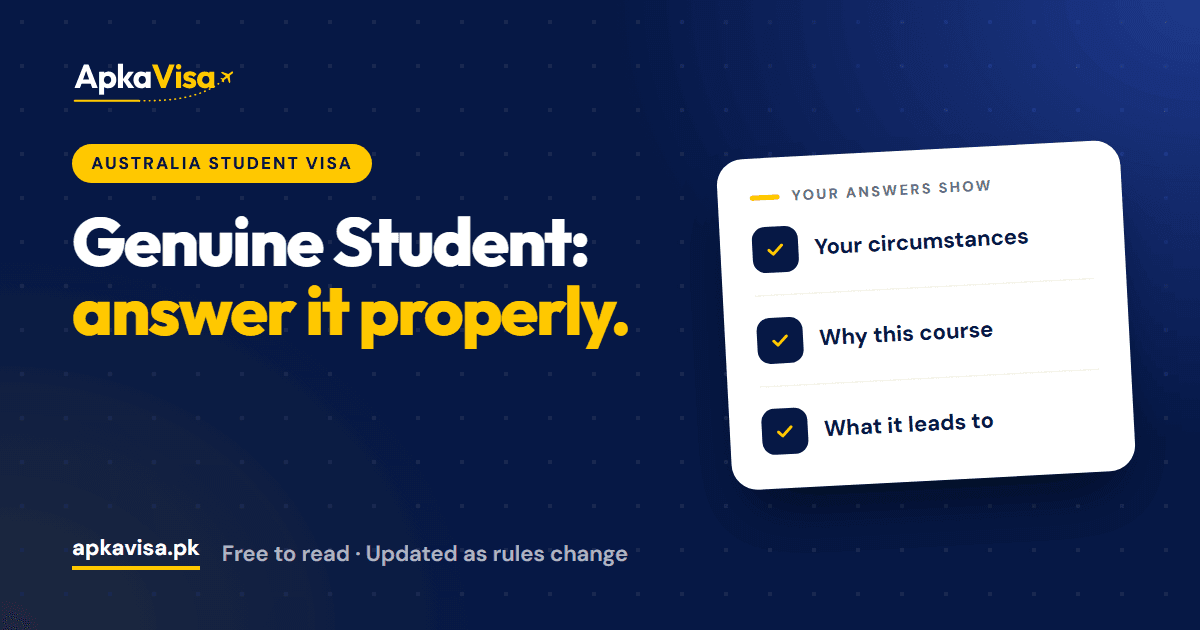
- Your current circumstances: ties to family, community and employment, and your economic situation
- Why this course, in Australia, with this provider — and what you understand about the course and about living there
- How completing the course will benefit you
- Any other relevant information
Question 1: your current circumstances
This is where you show what you have in Pakistan and why you will use the degree rather than the visa. In 150 words, cover who you live with and who depends on you, what you do now — study, a job, a family business — and the family’s economic position. Be specific: a job title, an employer, a year.
Then attach the evidence. The Department asks for details of your current employer and position, with the name and contact details of someone who can confirm it, plus documents showing employment or business activity for the 12 months before you apply, and tax returns or bank statements. For Pakistani applicants that usually means:
- An employment letter on letterhead giving dates, role and salary, with a contactable person, plus salary slips
- FBR tax returns or Active Taxpayer List status, for you or the parent paying
- For a family business: NTN, registration documents and the last year’s business bank statements
- Your NADRA Family Registration Certificate, showing who is in the family
- Land or property records as background — they show roots, not plans
Question 2: why this course, this provider and Australia
This is the answer most often written from a template, and it shows. A good one names the course and the provider and gives reasons that apply only to you: units that build on your degree, a provider whose strength fits your field, the campus city and why. It should show you know what the course involves — length, structure, assessment, any placement — and what living there will demand.
The Department also expects you to explain why you are not studying in Pakistan if a similar course is available here. “Australian degrees are better” is not a reason. A specialisation no Pakistani university offers, a professional accreditation your field values, or a research group in your area are reasons, and you should be able to name them.
Officers consider how much research you have done, so do it: the provider’s course pages, the unit list, accommodation options and realistic living costs.
Questions 3 and 4: the benefit, and anything else
Question 3 asks how the course will benefit you. The Department weighs whether it fits your current level of education, whether it is relevant to past or future work, and the salary and benefits it could bring in Pakistan or elsewhere. Be concrete: the kind of role, the kind of employer, and what changes with the qualification. An offer of employment after completion, or evidence of the salary for that role, carries more weight than an ambition.
Question 4 is optional but useful. Use it for anything that would otherwise raise a doubt: a study gap, an earlier refusal from any country, a change of field, or a course that steps down a level. One plain sentence and a supporting document beat leaving the officer to guess. Our post on explaining a study gap covers the evidence.
If you have already written a statement of purpose for your university, do not paste it in. Our guide to the SOP for a student visa explains how the two documents differ, and the answers should be cut to the facts that matter.
What Pakistani applicants commonly get wrong
These are the problems that come up again and again in GS answers:
- Copied or agent-written answers — the same phrases across many files are easy to spot
- Praising Australia instead of explaining your own plan
- Claims with nothing behind them: a job with no employer letter, a business with no bank records
- No reason for not taking a similar course in Pakistan
- A course that does not follow, such as a diploma after a master’s, with no explanation
- Answers that contradict the funds, the CV or the employment letter
- Leaving out a previous refusal from the UK, Canada or anywhere else
- Saying a spouse or children will join you later, when most coursework students can no longer bring family
The October 2026 dependants change and your GS answers
From 2 October 2026, most new Student visa applicants can no longer include a partner or children, and no Student visa holder can add family after the grant. The Department’s page on family members lists the exemptions: PhD students, DFAT- or Defence-sponsored students, foreign government scholarship recipients and eligible students from Pacific and ASEAN countries.
For a married coursework student, that changes how question 1 reads. A spouse and children staying in Pakistan are now part of your ties, so say who they live with and how they are supported while you study. Do not write that they will join you: under the new rules they cannot come as your dependants, and an answer built on that plan suggests you have misread the visa.
If you fall within an exemption, say so and attach the proof. Our post on taking your spouse on a student visa compares the rules in other countries.
What a GS refusal means
A refusal on the genuine student criterion means the officer was not satisfied that study is your real purpose. It is a judgement on your whole file, not a missing document, so a new application with the same answers and the same course usually meets the same result.
If you applied from Pakistan, the refusal letter will normally say there is no right of merits review. The practical route is a fresh application that deals with the reasons in the decision record: stronger evidence of your circumstances, a course and provider that follow from your background, and answers in your own words. Sometimes the honest fix is a different course.
The refusal also goes on your record. Australia, the UK, Canada and the US all ask whether you have ever been refused a visa, and leaving it out is treated far more seriously than the refusal itself. Our Australia student visa guide covers the rest of the application.
Frequently asked questions
This is general guidance