The short answer
What must Schengen travel insurance cover?
Schengen travel insurance is a legal requirement, not a formality. Article 15 of the EU Visa Code says every short-stay visa applicant must hold travel medical insurance covering the costs of repatriation for medical reasons, urgent medical attention, emergency hospital treatment or death during the stay.
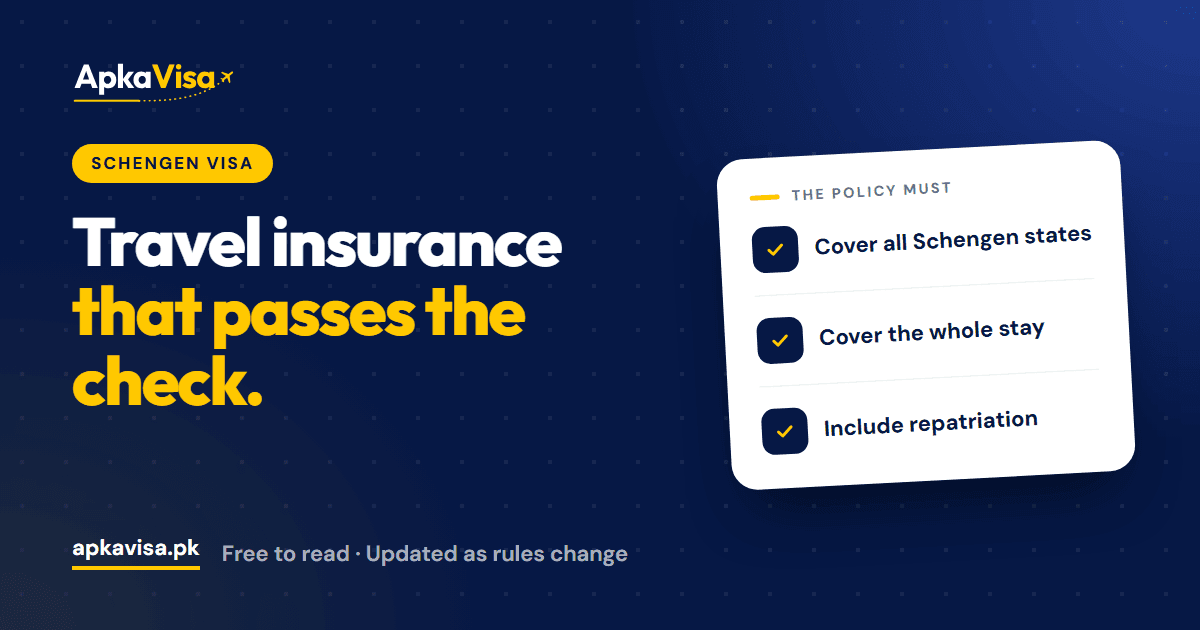
The policy must be valid throughout the Schengen area, not just in the country you apply to, and cover the entire period of your intended stay. The minimum cover is €30,000. The Visa Code says insurance should in principle be bought in your country of residence, which for most readers means a Pakistani insurer; someone else, such as your host, may buy it in your name. In short, the policy needs:
- At least €30,000 of cover
- Emergency medical treatment and hospital care
- Repatriation for medical reasons, and in case of death
- Validity in every Schengen country
- Cover from the day you enter to the day you leave
What do consulates check on the insurance certificate?
The officer reads the certificate against the rest of your file. Article 15 also tells consulates to check that a claim against the insurer could actually be recovered in a member state, so a policy from an unknown seller invites questions.
Every insurer in Pakistan must hold a certificate of registration from the SECP under the Insurance Ordinance 2000. A certificate from an unregistered seller, or one the insurer can’t confirm when the consulate checks, is worse than useless. On the certificate itself, the officer looks for:
- Your name and passport number exactly as in the passport
- Start and end dates that cover the stay on your form and in your bookings
- Territory shown as the Schengen states or Schengen area, not one country
- Cover of at least €30,000
- Medical emergencies, hospital treatment and repatriation named in the cover
- The insurer’s name, the policy number and an emergency assistance contact
Which Pakistani insurers do Schengen consulates accept?
Some embassies in Islamabad publish a list. The German embassy’s page on health insurance names 25 Pakistani general insurers and takaful operators, and the Swiss, Czech and Hungarian embassies publish the same list. Poland’s visa page refers to a list agreed among Schengen partners in Islamabad. The copies we found date from 2021 and 2022, so ask the embassy if your insurer is missing.
Other consulates, including Italy, Spain, France, the Netherlands, Belgium and Austria, publish no list on the visa pages we checked; for them, what matters is that the policy meets Article 15. If your destination does have a list, buy from a listed insurer — it removes a question the officer would otherwise have to ask.
Switzerland’s checklist adds one more rule worth knowing: it does not accept insurance that comes with a credit card.
Common Schengen travel insurance mistakes
Inadequate insurance is one of the reasons listed on the standard Schengen refusal form. The Commission’s handbook tells consulates to give applicants a chance to fix a faulty policy rather than refuse automatically, but don’t count on it. These are the mistakes that turn up most often.
| Mistake | Why it fails | The fix |
|---|---|---|
| Dates that don’t match | The policy starts after you land or ends before you fly home | Copy the dates from your form, flights and hotels, and check them on the certificate |
| Cover for one country | The Visa Code requires cover throughout the Schengen area | A policy that names all Schengen states |
| Cover below the minimum | Anything under €30,000 is inadequate by law | A certificate that states at least €30,000 |
| No repatriation | Repatriation for medical reasons and in case of death is mandatory | Check the wording lists it, not just “medical expenses” |
| Name or passport number wrong | The certificate doesn’t clearly belong to you | Copy details from the passport and check the printout |
| Exclusions that empty the cover | An age limit or pre-existing condition clause leaves nothing for an older traveller | Read the exclusions and declare conditions when you buy |
| Credit-card cover | The card’s papers rarely show cover, territory and dates; Switzerland refuses it outright | A standalone policy certificate |
How long should the policy run, and what about multiple entries?
For a single trip, insure the whole stay you plan. The Commission’s handbook says the policy covers your actual stay, not the full validity of the visa, and that the 15-day “period of grace” some visas carry need not be insured. If your insurance is shorter than the stay you ask for, the consulate may shorten the stay to match, or ask you for longer cover.
For a multiple-entry visa, Article 15 asks only for cover for the first intended visit, plus your signature on the application form’s statement that you will be insured on later trips. That signature is a promise: each later trip needs its own policy, carried with you. An annual multi-trip policy that covers the Schengen area is often simpler for frequent travellers.
Older travellers, pre-existing conditions and exclusions
Premiums rise with age, and some policies cap the age they cover or the cover they offer above a certain age. A cheap policy for a parent in their seventies may meet the €30,000 figure on paper but exclude the conditions most likely to put them in hospital.
Read the exclusions, not just the certificate. Pre-existing conditions, pregnancy and hazardous activities are common ones. Declare existing conditions when you buy: the consulate checks that the policy exists and meets the rules, but whether it pays is between you and the insurer, on the day you need it.
When and how to buy Schengen travel insurance
Buy the policy once your appointment is booked and your dates are fixed, so it matches the itinerary you submit. Our guide to Schengen visa appointments from Pakistan covers getting the slot, and the Schengen documents checklist covers the rest of the file.
If your dates move after you apply, ask the insurer to amend the policy rather than buying a second one. Print the certificate, keep a copy on your phone, and carry it when you travel. Arranging policies that meet the Article 15 rules is part of our travel insurance service.
Frequently asked questions
This is general guidance