Attestation or apostille?
Pakistan joined the Hague Apostille Convention in 2023, which changed the answer to this question and left a great deal of outdated advice circulating.
If your destination country is a member of the Convention, you generally need an apostille — a single certificate attached to the document — rather than the older chain ending in embassy legalisation.
If it is not a member, you still need the traditional route: verification by the issuing body, then the relevant national attestation, then the Ministry of Foreign Affairs, then the destination country's embassy in Islamabad.
Confirm which applies to your destination before you start. Doing the wrong one does not just waste money; it wastes weeks, and attestation timelines are the ones that most often derail a visa appointment.
Which documents actually need it
Not everything you have been told to attest genuinely needs attesting, and each unnecessary document adds cost and time.
Educational documents — degrees, transcripts, school certificates — are needed for study applications and for employment visas where the qualification is being relied on. Personal documents — birth, marriage, death certificates, police character certificates — are needed for family visas, dependant applications and most Gulf employment processes.
Ask the receiving institution or employer exactly which documents they require and in what form. Then attest those, plus a spare set, and nothing else.
The correct order
Sequence errors cause most delays. Each stage will refuse a document that has not completed the previous one, and you will not find out until you are standing at the counter.
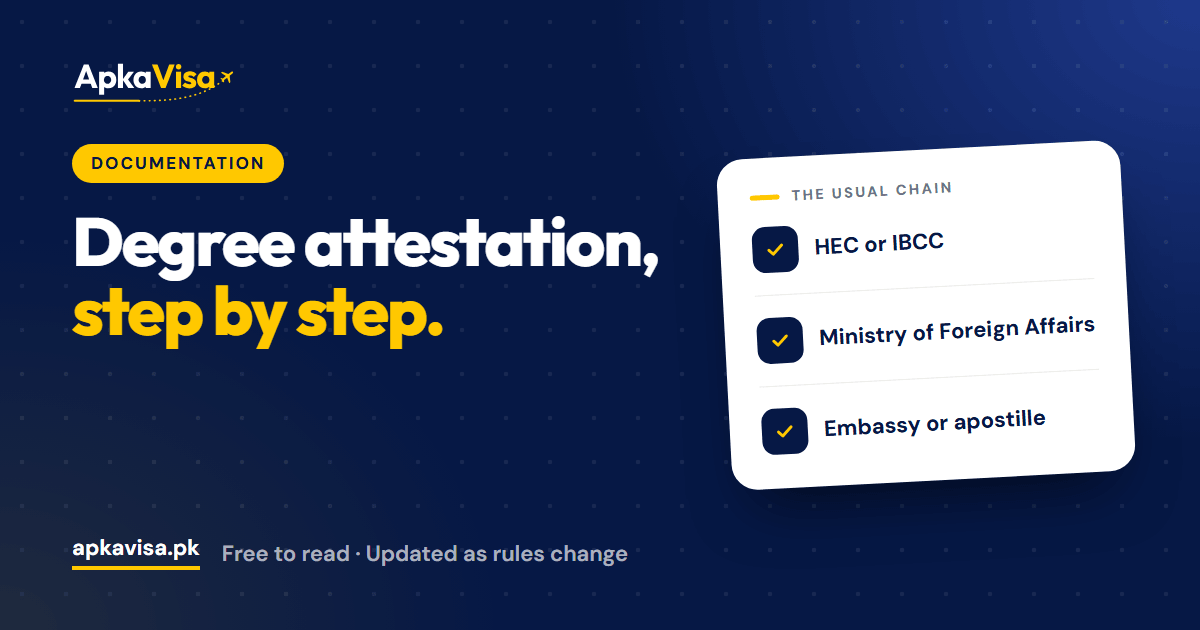
- Verification by the issuing university or board
- HEC attestation for higher education degrees and transcripts, or IBCC for matriculation and intermediate certificates
- MOFA attestation
- Apostille, or legalisation by the destination country's embassy for non-Convention countries
HEC attestation
The Higher Education Commission attests degrees and transcripts from recognised Pakistani universities, and it verifies them with the issuing institution as part of the process.
That verification step is where delays live. If your degree is already verified in HEC records the process is quick. If it is not — older degrees, some private universities, institutions slow to respond to verification requests — it can take considerably longer, and there is no way to speed up a university that does not reply.
Attestation is done on original documents. Bring the originals, along with your CNIC and photocopies. Check the current appointment and submission process before travelling to a centre, because it has changed more than once.
One thing worth knowing early: if your institution is not recognised by HEC, it cannot attest the degree at all. This is a hard stop, and it is better discovered now than after a foreign university has made you an offer.
IBCC for school certificates
Matriculation and intermediate certificates go to the Inter Board Coordination Commission rather than to HEC. Applicants routinely queue at the wrong body and lose a day.
IBCC also handles equivalence certificates, which convert foreign school qualifications into their Pakistani equivalent. If you studied O and A Levels, or completed schooling abroad, you may need that equivalence before anything else will accept the certificate.
MOFA attestation
The Ministry of Foreign Affairs attests documents that have already been attested by the relevant domestic body. It will not attest a degree that has not been through HEC, or a school certificate that has not been through IBCC.
MOFA is usually quicker than the stage before it, once the prerequisite is complete. It operates from several cities, so check where your nearest counter is rather than assuming a trip to Islamabad.
For personal documents such as birth and marriage certificates, the document generally needs to be the NADRA-issued computerised version. A handwritten or older certificate will usually need reissuing first, which is its own timeline.
Apostille or embassy legalisation
For Convention countries, the apostille is the final step and replaces embassy legalisation entirely. It is a standardised certificate, recognised by every other member, and it is the reason this process is now shorter than it used to be for much of Europe.
For non-Convention countries — which includes several Gulf states that a great many Pakistani workers travel to — you still need legalisation by that country's embassy after MOFA. Each embassy sets its own requirements, fees and timelines, and some require documents to be submitted through a designated service rather than directly.
Check the specific embassy's current requirements rather than assuming. This is the stage with the widest variation and the least predictable timing.
Translations
Some destinations require documents in their own language, and the translation usually has to be done by a translator the receiving authority recognises. A translation by someone unrecognised will be rejected regardless of its accuracy.
Where translation is needed, it generally happens after attestation, so that the attestation stamps are translated too. Confirm the order for your destination, because getting it backwards means paying for the translation twice.
How long it takes
HEC attestation commonly runs somewhere between one and three working weeks, longer where the degree is not already verified in HEC records or the university is slow to respond. Older degrees and some private institutions take noticeably longer.
MOFA is usually faster once the prerequisite is complete. Apostille adds a further step but is generally quicker than the embassy legalisation it replaced. Embassy legalisation depends entirely on the embassy and is the least predictable stage.
Budget four to six weeks end to end for a straightforward case, and start earlier than you think you need to. Attestation is the stage that most often delays a visa appointment, and unlike most delays it is entirely foreseeable.
Practical notes
Attestation requires original documents — copies cannot be stamped. Never hand originals to anyone, including a consultant, without a signed receipt listing exactly what was taken and when it will be returned.
Get more copies attested than you think you need. Universities, employers and embassies each want their own attested set, and coming back for a second round later costs the full timeline again. An extra attested set is cheap now and expensive in six weeks.
Check every stamp before you leave the counter. A name spelled differently from your passport, a wrong date, a missing signature — these are quick to correct on the spot and slow to correct afterwards.
Keep a scanned copy of every attested document. If an original is lost in transit, the scan is what lets you prove what existed and restart with a clear record.
Common mistakes
The ones we see most, all of them avoidable.
- Going to HEC with a school certificate, or to IBCC with a degree
- Attempting MOFA before the domestic attestation is complete
- Pursuing embassy legalisation for a country that now accepts an apostille
- Starting attestation after the visa appointment is already booked
- Attesting a single set, then needing three
- Using a handwritten certificate where the NADRA computerised version is required
- Translating before attesting, so the stamps are untranslated
This is general guidance